Tuesday, November 13, 2012

Vale Palmital

Vale Palmital - conhecido assim devido ao Córrego Palmital que tem sua nascente nas cercanias do Parque Infantil Monteiro Lobato, mais precisamente no Largo do Sapo, onde havia a famosa 'mina' com uma pequena piscina que servia de bebedouro para cavalos e gado que por ali passavam.

Por esse vale desliza o córrego através de terras fertilíssimas com vários afluentes, com uma vegetação frondosa nos trechos dos saltos, que são quatro. O vale se recobre de um imenso taboal e vai em direção à Dirceu.

A antiga Fazenda Palmital se transformou em um bairro operário chamado Vila Barros.

Valdeir Agostinelli escreveu em 11 February 2020:  Em minha opinião este não é o Vale do Palmital, mas o Vale do Barbosa, visto a partir do final da Rua Paulino da Silva Lavandeira (EMEI Chapeuzinho Vermelho), na Vila Fragata, próximo ao local onde moro.
a typical Marília street being paved with cobblestones... I lived on Rua Mato Grosso, 393... and it felt just like that... even though it was never paved (not while we lived there up to 1960). 

Sunday, October 28, 2012

Milaré Family

Comemoração da ordenação do Padre José Milaré Sobrinho, o Mila 1º, em 1953; Os padres da esquerda para a direita, em pé: pe. Nivaldo Restell, Padre Eurides, o de óculos desconheço. Sentados: Padre Chico (consta que só fumava cigarros Lincoln) e Padre Milaré.
Monsignor Luiz Bicudo ao centro. Pedro Millaré está de pé à direita.
José Augusto Milaré at pre-elementary school in 1957.

Friday, October 19, 2012

OCTAVIO LIGNELLI & PRI-2

um jovem Octavio Lignelli posa orgulhosamente ao lado de Francisco Alves, o cantor mais popular do Brasil das decadas de 30 e 40.
Octavio Lignelli acompanha Clarice Sanches e o cantor mariliense Francisco Alves. Monsignor José Millaré Sobrinho segura o microfone.
Clarice Sanches, dr. Antonio Augusto Avelar, advogado que morava na Avenida proximo ao 'Magalhães', Monsignor José Millaré Sobrinho e Octavio Lignelli esperam a hora de subir ao palco.
Octavio, sempre muito cuidadoso com crianças, ajuda a pequena rainha a se preparar para seu reinado.
Monsignor Millaré faz o mestre-de-cerimônia.
e o povo mirim assiste a tudo com muita atenção.
mais multidão mariliense...
Octavio Lignelli não era o Pied Piper de Merlin, mas empunhando seu violão, arrebanhava um exército de crianças para o auditório da Radio Clube de Marília nos anos 40s e 50s. Aqui vemos frente da casa onde funcionava a PRI-2 nos anos 1940, na esquina da Avenida Rio Branco com rua 24 de Dezembro.
Radio Club de Marilia quando funcionava em cima do Cine Bar, nos anos 1940s.
sacada da Radio Clube de Marília em 1953. Note ao fundo a torre única da original Igreja de Santo Antonio
Octavio Lignelli aparece um primeiro plano circundado de um mar infantil no auditório da Radio Clube de Marília numa solenidade noturna.

OCTAVIO  LIGNELLI 

Octávio Lignelli nasceu Batatais-SP a 25 Março 1918

Em 1936, com apenas 18 anos, viajou em tournee pelas principais cidades da América do Sul acompanhando um conjunto norte-americano de jazz.

Chega em Marília em 1937, vindo do Rio de Janeiro. Participou de várias audições de piano na PRI-2. Desenvolveu um método próprio para o ensino de violão tornando-se muito popular entre os marilienses.

Em 1938 cria o legendário “Programa Infantil” para a Radio Clube de Marília, aos domingos de manhã, acompanhando as crianças com seu regional. 

Além de suas atividades na PRI-2, Lignelli apresenta-se regularmente em recitais beneficentes no Marila Tennis Club, tendo tocado em 16 de julho de 1940, ao lado de Charmorro, executando peças clássicas como 'Vidalita', de Agustín Barrios, 'Celita' de Tarrega e 'Liebestraum', de Lizt.

Em 1943, Lignelli passou de diretor-artístico a gerente da PRI-2. Logo criou o 'Teatro do Lar', 'Apresentação Camo Valentim', 'Teatro Relâmpago', 'Apresentação Omar 'Nunes' Cardoso', 'Os Maiorias do Ritmo', 'Memento Romântico de Poesias' etc. Além de continuar tocando com Atílio Cizoto e Zozô.

Lignelli ainda apresentava-se regularmente na Sociedade Mariliandia, Chá Social etc.

Em 1946, criou o popularíssimo 'Oportunidade', programa de calouros que fêz história local, com apresentação de José Miguel Neto, revelando grandes nomes que partiram para outras paragens. 

De 1949 a 1969, Lignelli sempre foi figura exponencial no meio artístico-musical de Marília. Compôs musicas carnavalescas, acompanhou o conjunto Anjos da Cara Suja, além de estar sempre a postos para o acompanhamento musical das celebridades que visitavam a cidade-moça, entre os quais os cantores Francisco Alves, Orlando Silva, Sylvio Caldas, Vicente Celestino, Luiz Gonzaga, Gilberto Alves, Blecaute, Ivon Cury, Emilinha Borba, Marlene, Hebe Camargo (na época morena e sambista), Angela Maria, Cauby Peixoto, Carmélia Alves, Nelson Gonçalves, Anísio Silva, Maysa, Isaurinha Garcia e Elizeth Cardoso.

Deu apoio musical a figuras de teatro e cinema como Procópio Ferreira, Oscarito, Grande Otelo, Manuel da Nóbrega, Zé Fidelis, Pagano Sobrinho, Silvino Neto (pai de Paulo Silvino), Teixeira Filho, César de Alencar e Juca Chaves. E colaborou até com maestros do calibre de Ary Barroso e Sylvio Mazzucca, além de músicos renomáveis como Baden Powell e Luís Bordón.

Em 1955 tocou em programas de estúdio com a adorável pianista Amélia Brandão que residia em Marília e mais tarde, se tornou a querida e admirada Tia Amélia das emissoras paulistas.

Em 1958, foi contemplado pelo embaixador do Japão em nome do imperador com uma viagem ao Japão e um diploma, por ser considerado a “maior sensibilidade musical” e “O Mago das Cordas”. Nesta ocasião, compôs a segunda parte de uma musica de Massa Koga, que muito agradou a colônia japonesa. “O Diário de São Paulo” publica um artigo elogiando as seis musicas de Octavio Lignelli que foram gravadas: 'Flor do amor', 'Minha vida em suas mãos', 'Palco da vida', 'Longe dos arranha-céus', 'Cachoeira da ilusão' e 'Gotas do amor'. Na verdade, Octavio Lignelli compôs mais de 500 músicas entre clássicas e populares.

Em 1968, com 50 anos, venceu o I Festival do Compositor Mariliense, com “Desilusão”, interpretada por sua filha Lúcia Helena, ganhando o troféu “O cantador”.

Ao falecer exercia o cargo de delegado-regional da Associação das Emissoras de São Paulo, e gerente da rádio Itaipu FM.

Deixou a Rádio Clube de Marília, sua querida PRI-2, Rádio Itaipu FM e sua cidade que tanto amou, aos 12 de junho de 1983.

Octavio e seu Regional voltando de uma excursão pelo Paraná em 15 Novembro 1938.
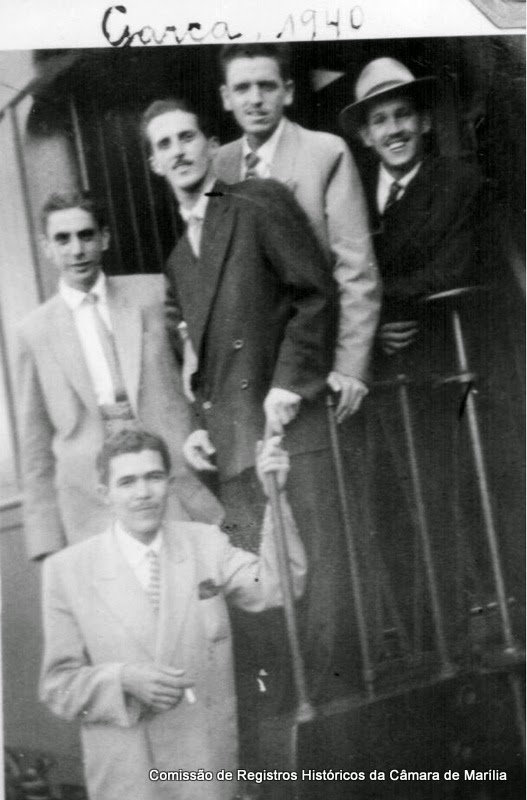
o Regional aproveita a parada em Garça para esticar as pernas - 1940.

Saturday, October 13, 2012

Instituto Vicente Themudo Lessa

the oldest picture we've got of the First Independent Presbyterian Church on Rua 4 de Abril. One can see the picket-fences and the Church standing alone with no other building around except those wooden houses on the far left.
Instituto Educacional Vicente Themudo Lessa on rua 4 de Abril had two entrances; one just between Cia. Telephonica and the Independent Presbyterian Church and the second entrance just past the church's gothic door.
Instituto Educacional Vicente Themudo Lessa, as the name itself says, was an educational institute - primary and secondary school - maintained by the Independent Presbyterian Church on rua 4 de Abril. It was a private school but their monthly payments were not too steep so a lot of children coming from middle-income families could attend its courses.

I was a student there for a brief period in 1960 when I took the Course for Admission to Gymnasium  - a 1 year-course preparing primary school graduates who wanted to go up to high school. That was the time when algebra, for instance, was first introduced to students.

Cezar Reis was a student there too. His family were members of the Independent Presbyterian Church so he has a lot to say about those years. 


It seems like you, Carlus Maximus and I have something in common. As you mentioned at the page 'Marilia seen from the air' you had gone to the Admission-Course-to-Gymnasium at Instituto Themudo Lessa I'd like to say I have also been educated at the same institution.

I grew up as a member of the Independent Presbyterian Church and had Sunday School at the premises of that school. My father and my brothers have also gone to high school there while my sister was at primary school. I went to kindergarten at Themudo Lessa so as you can see it was a family affair. Cezar Reis.
1 9 5 8 

Instituto Themudo Lessa's hall in 1958.
Primary school boys and girls in the court yard in 1958.  See the church on the right-hand side.
More primary school children wearing their uniforms pose for a photo on the side of the court.
5th grade (High School 1st grade as it was known in 1958) co-ed class. The boy circled in red is my brother Paulo Reis who lives in São Caetando do Sul-SP nowadays. The teacher usually wore a white overall to protect their clothes from the white chalk they wrote on blackboards.
Night school 5th grade B.  In Brazil it is common for kids from poor families to go to high school at night time. People from industrialized countrie can hardly believe that it is common practice in Brazil... but that is our reality. Kids barely in their teens start classes at 7:30 PM and go home around 10:30 or 11:00 PM. Here's one of such class. The teacher here avoided being photographed. The picture high-lighted on the wall is a celebratory art-work about São Paulo City's 400th anniversary in 1954.
U.S. company Good Year commissioned artist Vicente Caruzo to portray the city of São Paulo in its 400th year of existence. On the left one can see a Catholic priest indoctrinating the native population of São Paulo in 1554. On the right a beautiful woman holds São Paulo's flag and shows the exuberance of São Paulo's skyscrapers in 1954. I was really fascinated by this picture when I was a kid.
Night School 5th grade:  More kids going to school a t night - mostly girls - and older girls - plus a few 'mature' male students standing up against the wall.
6th grade co-ed class. The boy circled in red is Carlos Reis (born in 1943) my oldest brother who lives in Dracena-SP nowadays. The one circled in green is my cousin Alvaro (born in 1944) who worked for the São Paulo State Bank (Banespa) and is retired today. The one in white, not looking at the camera is Edgard who taught Latim and Portuguese. Latim was taught from the 5th grade onwards until 1962 when the government thought it was about time to abolish such a form of  mediaeval torture to the students.
Night School 6th grade -  One can see that mature students are the majority here. They were usually kids who neglected their education at government schools flunking two years in a row . After that they ended up being evicted from state schools having to transfer and pay for a private school to admit them. Younger kids who attended Night School usually came from poorer families and had to work as office boys and such during the day time.
7th grade  -  The higher the grade the fewer students per class. Here are some of the smart-alecks of 1958. Just joking! They are winners, actually. Notice the art work displayed on shelves at the back of the room:  they were the pride and joy of students' working assignments. 
Night School 7th grade -  Most of them were mature students. The one circled in red was my dearest father who decided he wanted to get his high school certificate. One should bear in mind that secondary education schools were almost non-existent in the 1930s in Marilia. The more prosperous families sent their sons and daughters away to have higher education in private boarding schools in Agudos-SP, Baurú and bigger towns.
Night School 8th grade - Top of heap! Mostly mature students as the grades became higher. The highlighted topic is a painting of three ripe figs done by my cousin Alvaro who was on 6th grade (2a.serie). 

Thursday, September 27, 2012

SCHOOLING since the 1930s

gorgeous straight lines of Marilia's Gymnasium built in the late 30s - Here's 1940.
Salve o lindo pendão da esperança, salve o símbola augusto da paz... 'Hymn to the National Flag'. 
same Gymnasium some years later.
First Primary School built in Marilia on Avenida Sampaio Vidal, 1936. Yolanda Darin graduated there in 1933.
Avenida Sampaio Vidal with the First Primary School seen on the left of the picture...
Grupo Escolar de Marília - 1933.
Yolanda Darin, first on the left, graduates from primary school in 1933.
Class of 1932 - the first graduation - Prof. Balthazar de Godoy Moreira sits in the centre.
Class of 1933 in which Yolanda Darin graduated.
Same year 1933 with a male-only class.
Grupo Escolar de Marilia
class of 1933.
Class of 1933 graduation memento.
1933 - director Balthazar, inspector and teachers.
more kids from the same school and year 1933.

Benedicto Estellita de Mello was Marilia's First Primary School's principal
this is a 1937 photo of a kinder-garten school in the corner of streets Lima e Costa and Paes Leme. It belonged to Saint Anthony's church. Hilda Grassi was one of the teachers there.
Grupo Escolar Thomaz Antonio Gonzaga - Setembro 1938. No verso está escrito: 'Meus saudosos colegas do tempo de Escola - Setembro 1938 - Vagner, Dovo, Antonio, Juscelino, Valdir, Geraldo, Amorim, Gerson, Pedrinho, Milton, Contor, Abilio.'  Na 2a. fileira de cima para baixo, menino à extrema direita é João Amorim.

From a wooden-frame structure in the 1930s the First Primary School - 1o. Grupo - on Avenida Sampaio Vidal moved to the corner of rua Pedro de Toledo and rua Rio Grande do Sul. This is circa 1947.
Trees have grown so much it covered the whole school front sometime in the 1950s. TAG is an acronym for Grupo Escolar Thomaz Antônio Gonzaga.
Building of  Escolas Gratuitas da Juventude Católica de Marília on Avenida República  aka Escolinha do Padre
dutiful mother takes her son to to TAG primary school in the 1940s.
Em 2012, o Grupo Escolar está quase como em 1945.
I would say this is circa 1936 or 1937.
Primary School 1940 - 3rd year female.
Class of 1948.
Class of 1950-something.
1o. ano primário; Escola Municipal de Vila Barbosa, on Rua Gonçalves Dias on 12 November 1953.
Catholic School Sacred Heart of Jesus in the 1950s.
School girls in front of Sagrado Coração de Jesus on rua Nelson Spielmann in the 1950s.

Em 28 Janeiro 1934, o jornal 'Alto Cafezal' noticiou a inauguração do Colégio do Sagrado Coração de JesusNa direção, a Rev. Madre Melânia Galli, digníssima Provincial e Revª Irmã Ângela Micheletto.

O Curso Ginasial foi instalado em 1937, com regimes de internato e externato só para meninas. Por esta razão é que eu fui aluno em 1936, na pré-escola. Nery Porchia.

School girls ready to cycle their bikes on 7 de Setembro march.
Class of 1954. 2o. Ano nas escadarias do Grupo Escolar Thomaz Antonio Gonzaga.
Grupo Escolar Duque de Caxias in 1948; this photo was published at FB as being from Marilia, but it is obviously not.
Escola Senai - National Industry Service - on Avenida - built in the 1950s.
Cia.Paulista de Estrada de Ferro.
Main Drag... Avenida Sampaio Vidal in the original cobblestones.